Thanks @Jynx
I'll tag a few others too who like updates, but this is going to be a long one so please please remember there is never expectation to read or respond. (Pressing a "support" button is also a very valid response to say "I hear what you say, and thank you for the update".) @Cuddlebear @Flutterbug9 @Shaz51 @Chasingsunsets @AuntGlow
There may be a funny(?) anecdote or 2 if I remember to include them - feel free to skim read only for that if you want. I am OK sharing these stories because if someone read them and knew this exact story already it means they already know me well enough that I am OK if they were to tell me they know my online profile, if they wanted to. I don't feel shame around them.
At least for the PAT I don't have to "organise" things (other than when I needed to get blood tests) - just "attend appointments" or say when I am available for the appointment. It's the DSP & NDIS applications / medical evidence I have to do myself. But now the medical evidence side for DSP is sitting with my MH GP (and our next 2 booked appointments), plus with a re-referral to a rheumatologist (for July for fibromyalgia). I don't think I will put in my mechanical back-injury pain for the DSP because I don't think it is impacting my ability to work - just the type of work I can do; so it's not worth the hassle to get my chiropractor to write up (especially since my CFS/ME/FM is the more restrictive/impactful physical constraint for working, back injury only adds pain with sitting or laying or standing -- which is an "on top" reason (in addition to caring about them as a person!) that I was interested learning about the other SANE-friend's experience because I've never had a doctor talk to me about pain relief options because I don't think I'm severe enough).
wrote:
Have you noticed any difference in how 'well-organised' you're able/unable to be since coming off the meds?
I'm not surprised that you're noticing you're quicker to reach tears when feeling overwhelm. Sometimes a belt loop or headphone cord stuck on a door handle is all it might take eh?
I still consider myself "well-organised" because I still have all my behavioural approaches that I've been using for a long time. So I have calendars, shopping lists, phone-alarms, keeping emails/messages "unread" until I've dealt with them fully, "starring" the super-important emails (eg appointment dates, forms I need to complete). However it is much more effortful to control my rapid-thinking (which has become more pronounced again since coming off the medication) to "pause, breath, calm. Now continue" because I will get so exhausted internally and then subsequently physically too. My already-strained short-term memory is now even worse (e.g. I will put my phone down to use my laptop, and then literally 30 seconds later need to my phone (to check a message or an MFA code) and I have no idea where I put it and spend another 30 seconds trying to find where I put it next to me - usually in my lap! In the past, i would know and remember where I placed it down next to me).
...but it's not "brain fog" in the sense that I recall having when I was a pre-teen or when I am extremely fatigued (eg working too many hours) -- I can think clearly and analytically and problem-solve still. I just can't recall things and need everything written down.
I found this week a 'treatment history' notes I had written 15 years ago in which I had said that when I started medication (now nearly 20 years ago) I didn't notice a change in mood but did have improved focus/concentration and slightly less fatigue. I still had chronic-fatigue from physical things, but mental fatigue. I had no memory of what I thought/felt within the years after starting medication, so this was a lightbulb for me that I will be sharing with the psychologist tomorrow for the ASD/ADHD/MH assessment part-2 (I hope I remember to - I might need to set an alarm to write it on a list of "updated thoughts" since the one I sent 2 weeks ago, and then a second alarm to remember to take the list to the appointment. I might even just print out this post to take with highlighted parts for me to read out!).
I am definitely experientially-remembering why I have at time over the past 20 years wondered to myself if I could be ADHD or bipolar. But I have always said to myself "no, that's not right" because:
- Bipolar: My bursts of energy are too quick/short (hours, not even a whole day); I don't have grandiose/unrealistic ideas, I just have bouts of motivation and energy to do achievable/realistic things (others would agree they are realistic). I'm pretty sure a psychiatrist would have picked up on it, given I have had 5 years of weekly psychiatrist appointments over my earlier life (i.e. they would have seen patterns of mania if they existed). And taking anti-depressants has never triggered these impulsive/energy bouts, if anything it has reduced them.
- ADHD: (Noting that I no longer believe these thoughts are correct - and I am glad my current assessment will include ADHD assessment so I can ask a psychologist's opinion) "I couldn't have ADHD, I have chronic fatigue. I'm too tired all the time. It's just my depression lifting that give me what must be "normal energy" for others, it's just that I am not used to it. Besides, I am able to force behavioural management to counteract these things like memory, inattention, not-noticing-time-passing, etc. Someone with ADHD can't do that without medication." (Of course I have no idea what "normal energy" for a person is though, because I've never had that. It's a concept like "happiness" that I hear/read about and can observe in others, but don't relate to experientially myself so I don't know what it feels like.)
Then it comes to... why do I get annoyed by friends' ADHD symptoms?
.... because I relate to all the symptoms but I put in a ton of effort to manage them! So I get frustrated when they are not open to or at least trying to use behavioural techniques and if they lack insight into or responsibility for their own behaviours. So basically... I get annoyed because all their symptoms are "normal" struggles for me . But I have empathy and compassion and love for them with regard to their ADHD symptoms because I recognise that they are doing their best to deal with the symptoms that impact their life the most negatively.
It the same reason that reading the book on ADHD was so emotionally dysregulating, as I mentioned to when they asked if I had read it. It's the same reason I "laugh and cry" at the ADHD memes - not all of them are "me" (e.g. ones about perfectionism or self-worth; I think my autistic-realistic-assessment-of-my-own-strength-and-weaknesses balances this out really healthily along with my early intensive psych treatments). But I have always been told by my mother I was "normal" and that all these things are "normal" traits across a spectrum (which is true) and it's only when they are severe enough that they become ADHD (or ASD) --- .... but I've never been asked how often or strong or emotionally-impactful these traits are. I've never been asked to take notice of how often I have immediate-memory loss or what I do in order to help me remember*.
*I literally walk down the hallway and don't know what I am doing at times. I have to look at what I am holding in my hands and then ask myself "why do I have this? what do I need to do with it?" to remember when I am doing. This occurs when I am in rapid-thinking cleaning-up-the-house mode. I have to tell myself "no, don't do that now - you need to finish this one first. Set an alarm for 5min to remind you to do the second thing."
I can't hold numbers in my mind without repeating them constantly, but if I need to also answer a question or think about what I am doing or what my "next step" is at the same time -- I'm stuffed. Thank goodness I know Auslan! I can physically sign the number to myself repetitively whilst I talk/think about whatever I need to be doing (e.g. think about which app on my phone I need to open to put in the number) -- so that when it comes to entering the number, I only need to see what number am I still signing to myself repeatedly .
It's this type of thing I have noticed a massive increase in since coming off my SNRI. ... I'm starting to think it's "not normal" levels of inattentive/memory. But its absent of brain-fog; I'm sharp.
I'm also now able to make sense of my emotional attachment to physical items. A few of you know I am currently advertising a car for sale. It wasn't my "first car" (which I only had for 2 years, but was also sad to part with) but it was my "first brand new car" that I have had for a over a decade. I personify her (like people with a boat, right?). But I am emotionally attached to her too - just like the car I had for 2 years. I put the ad up last week, and I was in tears because of it. But realising this emotional-attachment and emotional dysregulation can be autistic traits makes a lot of sense.
I'm also not going to be ashamed (or try not to be?) if I decide to take my own cushion-toy to my PAT session - because I know the psychiatrist is neuro-affirming/accepting and that within the context of autism it's not that uncommon. (I'm adding links in case anyone wants to read more to either understand or also feel self-validated if they resonate.) I love that I have a few other adult friends who are emotionally attached and love stuffed toys too - it has helped me shed shame over it and "normalise" it as acceptable because it doesn't cause any negative effects in my life (... except for hoarding tendencies -- but I am getting good at being able to rationalise and override these even if I end up upset in the moment).
I am able to see my illogical attachment as "funny" in a genuine sense. I can accept it as "part of me" now.
There are so many examples of this that I have realised when reading literature on AuDHD. The internal struggle between the need for routine/structure/order/logic and the uncomfortable impulsive sensations. The amazing memory for details (when i'm interested or it is important to me) contrasted with the terrible lack of memory for trivial or uninteresting things (e.g. dates & name in History... ...But I can tell you all about what I learn about castles & medieval history when I was 14, just not the names or dates - because who cares? It's the concepts that are important & interesting to me). It sort of makes sense of why I can recognise voices but rarely faces unless I have met someone many times (familiarity) - and I do remember names of people at work if I have seen them written down before (but not if auditory).
It makes sense of why the consistent feedback in my Auslan 10+ years ago was "very expressive signs" but "sloppy" form (which is also why people think I am Deaf and not a learned-student-signer), but that in interpreting-tasks (where I have to explain what was said in English) I "need to pay attention (not complacent) to the tone/attitude". This last one always confused me because I understood the emotion/attitude of what I was watching/interpreting, so I just ignored it thinking they must have misunderstood me (there was never line-by-line feedback in those assessments). Now though, with my assessments from the past 2 months in Auslan, I realise that the problem is I am not directly stating the attitude/tones because I see them as "obvious and implied" in my answers! But I only have the awareness of this because the assessor has explicitly asked me clarification on this aspect of my understanding of what was signed because I didn't explain it in the written component. They knew I understood what was being said because I could give a very detailed summary (as long as I used my notes I took whilst watching, because short term memory!) of all the points - and I then when asked I could say "that was a negative because..." or "that was a positive because..."
It also makes sense within AuDHD focus & dysregulation of why I can usually understand/process spoken English. But if I am have been focused on something and then someone breaks it to get my attention to ask a simple question ("would you like a drink?") I have a lot of difficulty in comprehending (processing) what the question means, also in thinking of the answer (e.g. to "what is the name of your therapist?" despite having seen my therapist weekly for more than 6 months! I mean, I know her name - I just can't always recall it without a lot of effort - it's sometimes easy and sometimes really hard).
I have often been asked if I am an Auslan interpreter (and strongly encouraged by friends to train into becoming one) but as I have always explained to my friends, I can't do interpreting reliably. I have occasional auditory-processing problems and difficulty remembering what was said "a paragraph-ago" if I am simultaneously explaining the previous point, along with the challenge at times of this auditory-processing needing to be done whilst also remembering what I need to express from the previous paragraph!
But I can do 1:1 (or 'sequential talking') interpreting 99% of the time . I struggle to do lecturers or group-conversations-without-people-waiting-for-answers. (Note I say "interpreting", I don't do this professionally & I am not qualified. But i will assist friends in a social capacity when we are going places, or help out in a social event if they have been unable to book an interpreter. This is how I know what I can or cannot do from experience.)
There is so much about AuDHD that "makes sense" of my life experience. But that's why it feels threatening that I might not get a diagnosis of it - but I counter that by the knowledge that if it's not AuDHD, then the psychologist will explain to me what it is instead and that is also sense-making which will help. . And either way, regardless of the cause, the symptoms and functional impacts are still just as valid and affecting in my life. An "other-diagnosis" doesn't have to diminish the impact that these traits are having on my life, and I trust the psychologist will reflect her assessment of the impacts in the functional capacity assessment regardless of the diagnostic cause it is attributed to.
... but the uncertainty, despite being able to rationalise it and not actually be worried mentally about the outcome? I don't feel comfortable, I feel symptoms of anxiety (butterflies, muscle spasms) from the uncertainty. I just want the answer already lol !! (I totally see how this could also be an autistic trait of needing clarity/certainty . I find it funny.)
My life has become a comedy each day
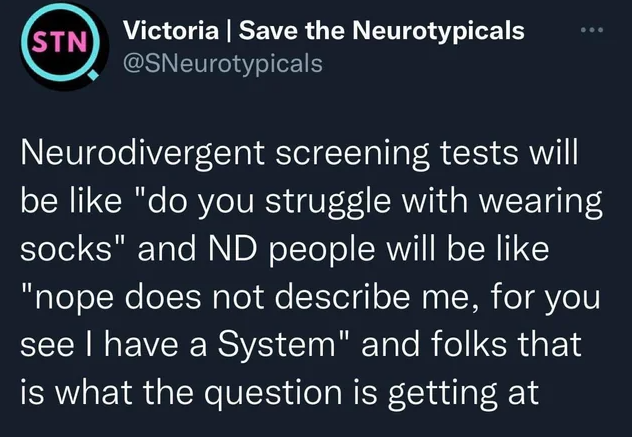
- Anecdotes of not being able to answer questionnaires because "I don't know what's normal" or because "No, because I do this (masking behaviour) -- oh wait, that's important right? Because I do have those traits it's just that I override them? So, how am I meant to answer this question - because it asks how often I do it, but I don't do it because I know it's innappropriate to do it (or I already have done in previously and thus no longer need to do it, and they're only asking about the last week or "daily" averages)..."
- Realisations on why I cannot (or find very difficult) eat certain foods (answer: textures and strong flavours, these are consistent themes)
- Realisations after-the-fact that someone has asked a question, I have taken it "too literally" and my answer was "missing the point", or that I don't realise that I do things until later when I catch myself doing it - because it's never been a "problematic" behaviour. ("Do you ever walk on the sides of your feet?" ...No. But me later? "Oh, I do rock/stand on the sides of my feet when I am standing still (eg reading a sign, or unable to pace whilst waiting) - but not whilst I am walking. ... I guess maybe that's still included in what they meant though maybe? But I'm still not sure..." )
- I don't know that my body is sending me "uncomfortable" signals until I get agitated or physical-muscle-spasm. But now experience this physically since coming off my medication (absence of blunting) I "check in" with myself and realise that I am "too cold" or "too hot/humid" or "have pain in my ..." or "need to go to the toilet". I also find this lack of passive interoception very funny. It's all manual "pause and check" effort unless it comes to urgent or extreme. It makes a lot of sense of my pain-tolerance for chronic pain and my pain-sensitivity for fibromyalgia-like symptoms.
This post is now way too long so I will end it here. It's taken me 2 hours to type but the time of course feels like 20 minutes. I have an alarm set for 1.5 hours for when I need to get ready to go out, so now I shall try to read some of the 200+ SANE notification emails of where I have been tagged that I have not read since the past fortnight . See if I can knock off a few of them! (Some are group-tags I don't need to reply to, some are things i have replied to because of reading a thread from an earlier tag - but I haven't read it via the email, so I just need to delete the email. So it's really not as bad as it sounds -- it's just a matter of figuring out which ones I genuinely haven't read/replied to yet!)
PS - my female dog has been getting into all sorts of mischief the past 2 weeks. Almost every day she has stolen something when I have left the house. Yesterday I dog-proofed my house quite well before leaving, but turns out she snuck into my mother's room whilst she was home but without her noticing and stole some vitamin/herbal tablets. She's OK - she doesn't even seem to have gastro from it? I am very lucky. She now has colour-stained paws and cushion from the capsule powder though. ... and my mum has $20 less of capsules that she buys online because you can't buy them in-store (they're legal, just not commercially viable for mainstream pharmacies to stock in-store?).
PPS - I also had firetrucks outside my (owned-but-rented) apartment this week. Thankfully a neighbour was able to confirm for me that it wasn't our building on fire, it's was the attached-adjacent building. I feel very sorry for them, but so relieved that it wasn't our building (it would be a headache I don't need right now). . A literal fire to top off the metaphorical one!
My week has been "fun".
Please do feel allowed to laugh. Lets at least have some silver-lining of all the stress, right?