FORUMS

Connect with people who understand what you are going through, seek advice and surround yourself with support. We're free, anonymous, and professionally moderated 24/7.

  • 47,612Members
  • 1,358,869Posts
  • 1,400,000Visitors
Talking through trauma and PTSD

Acceptance is hard work

Acceptance is hard work

Before I start, I just want to say…that I don’t feel comfortable in this space. It’s hard to be in the trauma and PTSD forum, but for me at the moment, I’m working through a level of acceptance.

I don’t have a diagnosis, I’ve never spoken to or seen a counsellor, or received any kind of mental health support. I have a very good friend who works in a healing space and has seen and experienced the impact my mental health and my triggers has on me. She has a lived experience of CPTSD and she knows a little of my story. She has helped me with resources and just by being a wonderful safe space for me to talk about what I’m experiencing. She suggested that perhaps, I could be experiencing the symptoms of CPTSD.

I completed a self-referral for the guided recovery program and have started that process. It has me straddling the line of acceptance. I have always had “anxiety” and have experienced panic attacks and flash backs and all of those good things. My first memories of my anxiety was when I was a teenager. But now, I accept that it isn’t entirely accurate.

My brain’s blocked out some of my memories of what happened to me. Logically, I know that it happened, but it was as if…if I couldn’t remember it all, then maybe I could live with doubt and maybe that doubt was permission to say…”you know what? Maybe It’s not real.” And if it didn’t really happen, then I don’t have CPTSD.

I will also acknowledge that I have been fairly avoidant with seeking help for a number of reasons, but one of those reasons is because I don’t want to talk about/acknowledge that what happened, actually happened.

I’m in a space at the moment where I know that the first step for me is actually owning it and accepting it. But, that makes me feel very vulnerable, and the acceptance feels “slippery,” I can’t quite wrap my head around it, as if a part of me is protecting me from it, if that makes sense.

Last year, a friend (who is no longer a friend) told me in an argument that I use my anxiety “as an excuse” and maybe she’s right - but not in the context she meant it. I’ve used my anxiety as an excuse not to acknowledge that there’s something else behind it. Is acceptance something that you let happen organically as you move through life, and counselling and all the processes? Or is this something that you push yourself through, knowing that it’s an important step? How do you work through this process of arriving at acceptance on multiple levels?

@Jynx @rav3n @tyme and I don’t know who else to tag, I’m sorry.
3920 replies

2,941 - 2,950 of 3,920

In response to: Acceptance is hard work

Re: Acceptance is hard work

@NightFury totally understandable that you're used to it hun. In fact, I think this can be one of the great challenges of healing - humans are drawn to what feels most comfortable, even if what is comfortable is suppression and self-criticism. Cos maybe that's what kept us safe in the past!! Which it sounds like it did for you - you learned to suppress your joy to avoid getting shut down or criticised. What that can mean is that we internalise that criticism and even when we're alone, we still struggle to express those emotions without becoming self-critical. Even though there's no longer a 'punishment', our nervous systems are conditioned to expect one!

Something I've tried to incorporate for myself is this idea that like.... if I can be harshly critical of every tiny mistake, I can also be wildly celebratory of every tiny success. Takes time and a bit of practice but it does help!

Hope you're having a chill Thursday 😊

In response to: Acceptance is hard work

Re: Acceptance is hard work

I know, but I've also allowed myself days and times of rest during these holidays @tyme things have only really started to get busy again this week.

I hope it goes well to. Now that I have a diagnosis, I can apply for an access plan, which gives me extra time and extra supports. I have the paper work sitting in my inbox for my GP to fill out but I haven't decided if I'm going to use it or not, if it feels okay for me to use it or not.

My contract ends on the 20th of Jan, so I have been getting paid my holidays, but may not be paid from the 20th.

So with the new role, I start off in training. I have to spend 10 weeks learning the ropes, shadowing staff and doing modules and what not and then when I'm signed off on that, I'll start to work supervised to begin with, then transition to 1:1.

In response to: Re: Acceptance is hard work

Re: Acceptance is hard work

I don't even know where today disappeared to @Jynx I accidentally fell into an assigment at 10 am and didn't come out until 2.30 pm, when I realised that I hadn't eaten or had anything to drink all day.

I think that's a big one for me. Allowing myself to fully feel and express the positive emotions is such a challenge. I suppress all emotions, but it is kinda sad that I even suppress the good stuff. I look at people around me who laugh and run and play and are clearly having the best of time and I often wish that I had a little of that spark in me.

In response to: Re: Acceptance is hard work

Re: Acceptance is hard work

@NightFury ahaha that hyperfocus will getcha!

Would you believe me if I told you that spark is still in you? Inner child work can be very challenging but incredibly healing. There's this quote I really like, 'You don't stop playing when you get old, you get old when you stop playing.'

I think play is a very undervalued aspect of recovery! We can introduce it really slowly too, doesn't have to be all or nothing. Simple stuff like crunching leaves underfoot, singing made up songs (I sing to my cats, makes it a little easier to let myself get silly with it), rewatching nostalgic TV shows, wearing more colour, getting crafty with like colouring in or Lego or making beaded bracelets or something. Sometimes it can feel really scary, especially cos a lot of us are socialised to believe that 'maturity' = stoicism. If it feels too confronting to tap into that more childlike wonder, you can also try to reconnect to your adolescence.

In response to: Re: Acceptance is hard work

Re: Acceptance is hard work

Teaching allowed me to play a little @Jynx I loved moments where I got to sit with a student and draw, or when we went on excursions to the park and I got on the swings. It was easier to join in with the kids than it is to push past my own judgements and play when I'm not in teacher mode, or out in public with adults or even when at home by myself.

I don't know, Jynx. It's there, but it isn't as bright or as free as other people's.

My mood has kind of crashed (not really as a result of this conversation, don't worry), so I'm going to head to bed. Good night, Jynx.

In response to: Re: Acceptance is hard work

Re: Acceptance is hard work

All good @NightFury might catch you tomorrow 😊 We can keep chatting on this or can chat about whatever you like - I'm open to whatever. Hope you have a good rest deary 💜

In response to: Re: Acceptance is hard work

Re: Acceptance is hard work

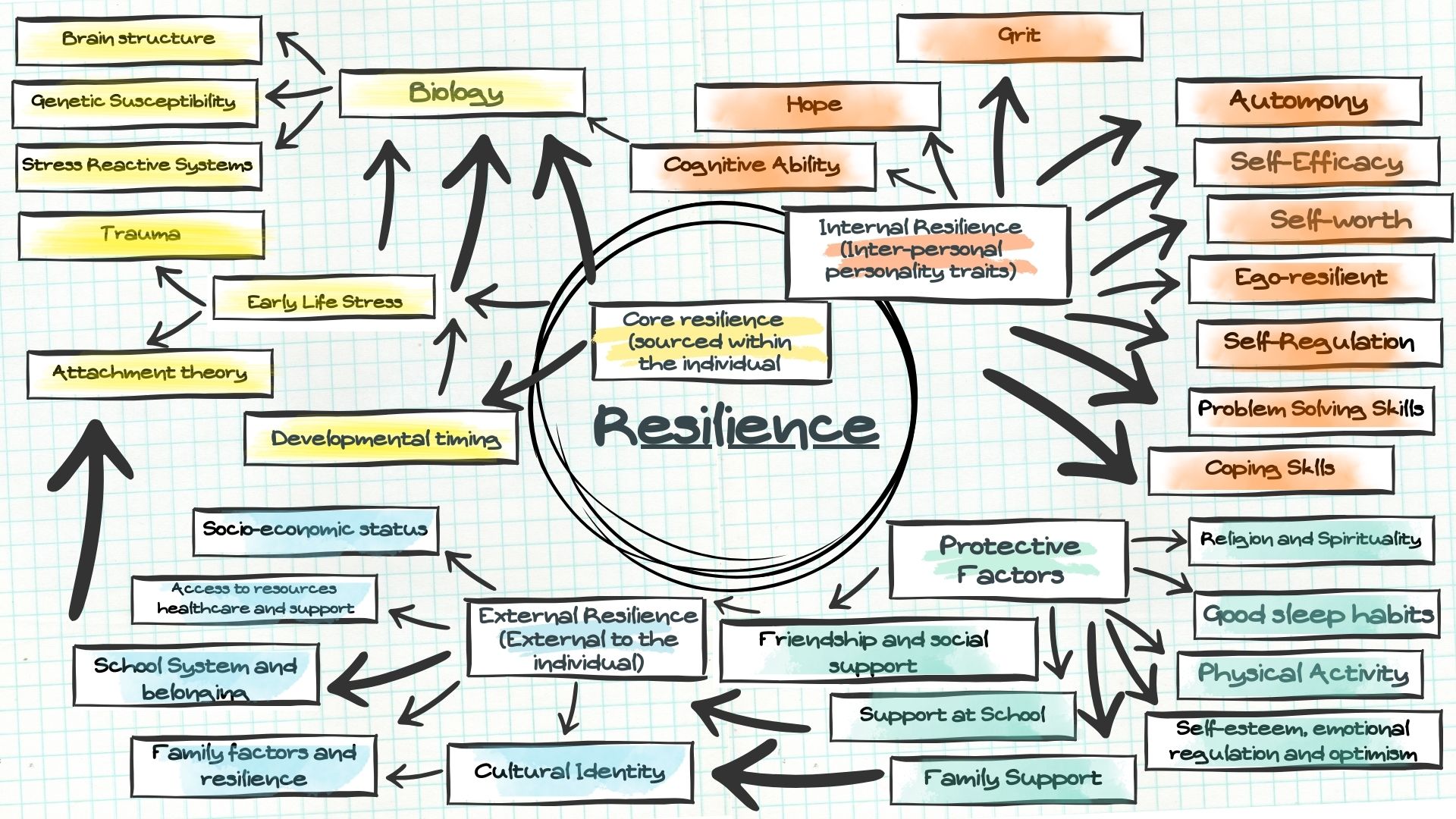
@AuntGlow @Jynx @tyme @Shaz51 @AlwaysMyself If you're interested...this is what I've been working on for my first assignment - a mind map of the components of resilience. I also had to write a 200 word answer that applies the components to an example of a student or situation you might come across in a school, and another 200 words that critically explains how improved resilience also has a positive impact on social and emotional regulation.

In response to: Re: Acceptance is hard work

Re: Acceptance is hard work

@NightFury😍looking forward to when the image is approved and comes through! Very keen to see! 🥰 thank you for sharing.

Ah ha ha we must be in sync today @NightFury cos guess what one of the things i mentioned to my counsellor was today? About how seeing expressions of positive emotions in other people feels to me 😅 (it varies based on the cause for the emotion) and how it feels so unnatural and uncomfortable for me 😅.

As a teen i saw things too seriously (understandably - i was dealing with severe depression, less regulated distressing emotions, and and lots of SI) and felt really disconnected from "playfulness" and "frivolity". The memories if my friends playing at school still make me cringe inwardly lol -- but they were totally normal! I was the odd duck lol. I made a deliberate decision in my mid-20's to introduce some "frivolous" things to my life -- that felt easier than "playful". That's when i decided on 2 "rules" and to learn to make ice cream (to experiment with flavours). I decided novelty was a good "positive frivolous" for me. I can sometimes be "playful", but it doesnt feel natural to me and is exausting -- unless it is teasing a close friend with sarcasm or a personal joke topic from a past event (in a positive way!)

@Jynx

In response to: Re: Acceptance is hard work

Re: Acceptance is hard work

@NightFury pic approved yay!

I love it 😍😍😍 and it makes a lot of sense even without any explanation text. Well done!!

The youth mentoring program i've done helps teens identify the "internal resilience" factors (but not indepth like counselling does, but at a supportive/reflective/guided way) as well as helping them identify "external resilience" supports they can reach out to (since the program is only 20 weeks and is designed to help improve/setup resilience). 🥰

In response to: Re: Acceptance is hard work

Re: Acceptance is hard work

Resilience is more complex than I thought @AlwaysMyself

Sounds like you and I have had a very similar conversation, AlwaysMyself. I don't know if I feel uncomfortable around other people expressing positive emotions, I just often wish that I had the same spark or the same ability to be that expressive. When other people cry is another thing...I never really know how to respond to that. I'm not hugger...so...

2,941 - 2,950 of 3,920
