Hello @1stepup61
{Long post - I hope interesting}
Edit Note: 1.30 am Wed. 10th November '21. My knowledge of aeroplanes, "Flying Boats" and the services operated pre, during and post WW II, has been significantly increased since I commenced this project, and has changed some of the ideas and observations that I have made and expressed when I first posted this article. However, the actual sourced information is correct to the best of my knowledge. @HenryX
I notice that you have rejoined as a forum member after some time away, so I have not seen you around. I rejoined the forum in Feb. this year and have found the discussions to be useful, informative and interesting. Many members have offered pleasant and helpful interactions and support.
Thank you for your request for information on the possible aircraft in which your relative may have flown from Sydney to Los Angeles. Most of the information that follows is from Wikipedia websites.
Such a flight might have been organised as what we would refer to as a charter flight these days. Possibly a number of adventurous people, an aeroplane and a pilot, who all wanted to go in the same direction.
I have found one specific reference to a flight that indicates that such flights were taken which was recorded as follows:
P.G. Taylor:
Pioneer return flight Australia to South America; on the 13 March to the 21 April 1951, in Consolidated Catalina;
VH-ASA Frigate Bird II (ex RAAF A24-385) transferred 22.8.50,
withdrawn 28.6.54 for later museum display
Below:
Basic Inputs:
Flight distance from Sydney to Hawaii is 5,100 miles (8,210 km) {with island rests and refuel stops en route.}
Flight distance from Hawaii to Los Angeles is 2,556 miles (4113 km) in just one leg {no refuel points between the two locations.}
So the longest single leg would be from Hawaii to Los Angeles a distance of ~4200 km.
The Douglas Aircraft Company DC-4 and DC-6 planes {see more details following the "flying boat" entries} would have had the range to cover the distances.
** Update: {"I have the idea that the flights may not have been favoured over large stretches of ocean, because of the limited radio communications at the time." - This assumption of mine, included in the original text of this post, is incorrect, as shown in the following extract from a subsequent post:
"The reason that I suggested the DC-4 was because:
Between 1946 and 1954, BCPA flew across the Pacific. (to America) However, BCPA was a post-war virtual airline. It chartered all the flights to Australian National Airways and their Douglas DC-4s."}"
The Catalina "Flying Boat", with auxiliary fuel tanks installed, would likely have been able to make that flight. The Catalinas used to fly from Perth to Singapore and return, a distance of 3,900 km each way, and later, directly {no Stops} to Sri Lanka from Perth, a distance of 6,480 km each way.
Before, during and after WW11, much use was made of "Flying Boats" or "Seaplanes". At the beginning of this thread, I have given some details on the Catalina “Flying Boat”. These had, in some configurations, an operational range of over 6,480 km. The longest leg of 4,200 km, from Hawaii to Los Angeles would be achievable, but I do not think that it would be a comfortable flight. However, even small planes fly that route now, when being ferried from the US.
The Consolidated PBY Catalina is a flying boat and amphibious aircraft that was produced in the 1930s and 1940s. In Canadian service it was known as the Canso. It was one of the most widely used seaplanes of World War II. Catalinas served with every branch of the United States Armed Forces and in the air forces and navies of many other nations. The last military PBYs served until the 1980s. As of 2021, 86 years after its first flight, the aircraft continues to fly as a waterbomber (or airtanker) in aerial firefighting operations in some parts of the world. None remain in military service.

S.23 Empire G-AETV, "Flying Boat" named 'Coriolanus',
moored at Pinkenba on the Brisbane River, 1939
"Flying Boats" or "seaplanes" were used by the British Overseas Airways Corporation (BOAC) in air services between the United Kingdom and Australia. This would presumably have been because of limited or no landing strips or aerodromes in many of the locations to which flights were made. It would also have allowed for flights to any location where suitable water landing areas were available, meaning that they were not limited by the need for access to airfields. Generally flights were more for essential distribution services and delivery of mail and government documents, but also carried passengers in what was relative comfort during those times.
Details of Royal Australian Air Force /Qantas air service to Singapore and later to Ceylon (now Sri Lanka) during the war are presented on the following website and an outline follows:
https://en.wikipedia.org/wiki/The_Double_Sunrise
In 1943, Royal Australian Air Force personnel were seconded to operate Consolidated PBY Catalina seaplane aircraft under the banner of Qantas. The plan called for flights between Crawley, Western Australia, and RAF Base Koggala in southern Ceylon. Now called Sri Lanka. The flights were (then) the longest non-stop air route of any airline, over 3,500 nautical miles (6,480 km, 4,020 mi) across the Indian Ocean. Navigating without the aid of radio, the crews relied solely on rudimentary navigation by compass and stars during the trip.
Douglas Aircraft Company
Passenger carrying capacity often varies, according to the configuration and specification designated, and the purpose for which the aircraft is to be used.
The DC-2 {from 1934, with Trans World Airlines} pass cap. = 14. Range 1,600 km
The DC-3 {from 1936, with American Airlines} pass cap. = 21 to 32. Range 2,500 km
Douglas DC-3 {below}
The first successful commercial propeller-driven airliner

The DC-4 {from 1942 with United Airlines} pass cap = 44. Range = 5,300 km
The Douglas DC-4 {below} a four-engine aircraft with tricycle undercarriage introduced {1942 with United Airlines}.

The DC-6 {from 1947 with American Airlines and United Airlines}
pass cap. = ~50 Range = 7,400 km
DC-6 {below}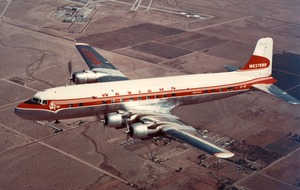
Another Era
The Lockheed Constellation (below) is a propeller-driven, four-engined airliner built by Lockheed Corporation starting in 1943. The Constellation series was the first pressurized-cabin civil airliner series to go into widespread use. Wikipedia
Lockheed Super Constellation built by the Lockheed Corporation
Pass. capacity = 62 - 95+. Range = 8,700 km
Produced: 1943–1958
First flight: January 9, 1943
Number built: 856
Retired: 1990s, airline service; 1978, military
Introduction: 1943 with USAAF; 1945 with TWA
Qantas Lockheed Super Constellation below
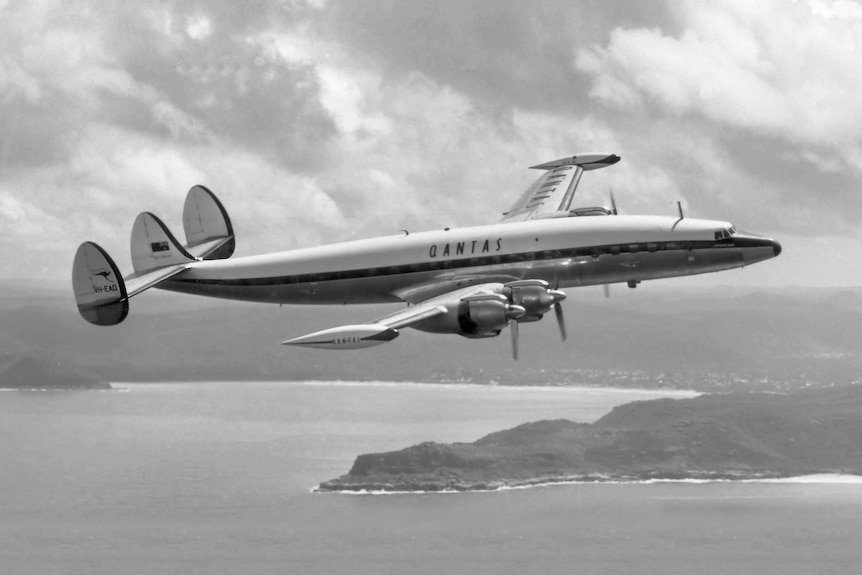 Lockheed Super Constellation flying in the 1950s.(Supplied: Qantas Heritage Centre)
Details of the Australian restoration of one of these planes are on the following websites: {which can be accessed by the links}
https://www.abc.net.au/news/2018-07-16/qantas-super-constellation-plane-restored-in-longreach/9962624
And more on this website:
https://edition.cnn.com/travel/article/qantas-super-constellation-restored/index.html
 A preserved C-121C Super Constellation, registration N73544, in flight in 2004
I remember seeing a Super Constellation flying over Brisbane when I was a child.
And I have just found out that the "Flying Boat" moorings were at Pinkenba, 5 km down-river from where I lived at Bulimba, on a loop of the Brisbane River, and adjacent to a Water Transport Depot. These details allow me to understand why I remembered seeing the flying boats taking off from the river. Gosh, you learn something new, that is old, everyday.
So, I am able to thank you for that bit of my own history, @1stepup61 , that is certainly interesting to me. Thank you.
I hope that the information that I have offered is of interest and will help in determining the type of plane in which your relative may have travelled.
With My Very Best Wishes
@HenryX